
Accessible Canada Act digital accessibility requirements became significantly more specific on December 5, 2025, when the federal government registered the Digital Technologies Accessibility Regulations under the Accessible Canada Act. These amendments set concrete technical standards and hard compliance deadlines for federal public sector organizations and federally regulated private businesses. The deadlines are December 5, 2027 and December 5, 2028, depending on the type and size of the organization. For anyone in a Crown corporation, federal agency, bank, major transportation company, or other federally regulated entity who manages websites, mobile applications, or digital documents, those dates are closer than they appear, and the preparation work is substantive.
This guide explains what the Accessible Canada Act requires, which organizations are covered, what the technical standard actually means in practice, and why beginning accessibility work in 2026 is the strategic choice rather than the reactive one.
Turn your website into a search-driven growth engine
Boost Your Rankings with AI-Powered Semantic SEO
Take the next step toward higher visibility and stronger conversions.
What the Accessible Canada Act Actually Requires — and Why 2025 Changed Everything
The Accessible Canada Act received Royal Assent on June 21, 2019. Its stated purpose is to achieve a barrier-free Canada by January 1, 2040, by identifying, removing, and preventing barriers across seven areas: employment, the built environment, information and communication technologies, communications, procurement of goods and services, design and delivery of programs and services, and transportation.
The original 2021 regulations under the Act focused on accessibility planning and reporting. Organizations subject to the Act were required to publish accessibility plans, establish feedback processes, and file progress reports on a three-year cycle. Large federally regulated private organizations, those with 100 or more employees, submitted their first plan by June 1, 2023, with the next reporting deadline in June 2026. Those requirements are already in effect and ongoing.
What changed in December 2025 was the addition of specific digital technology requirements. The new amendments, formally titled the Regulations Amending the Accessible Canada Regulations, incorporated Canada’s national ICT accessibility standard into law. As of their registration on December 5, 2025, the technical standard CAN/ASC-EN 301 549:2024 is now the mandatory benchmark for digital accessibility compliance for covered organizations. The standard was adopted by Accessibility Standards Canada in May 2024, based on the European EN 301 549 v.3.2.1, which itself incorporates WCAG 2.1 Level AA requirements for web content and extends coverage to mobile applications, software, hardware, and digital documents. This is the most comprehensive digital accessibility standard currently in use internationally, and Canada has now made it enforceable at the federal level.
Which Organizations Are Covered Under the Accessible Canada Act
The Accessible Canada Act applies to the federal public sector and to private-sector organizations under federal jurisdiction. Understanding whether your organization falls within scope is the necessary first step.
Federal Public Sector Organizations
This category includes federal government departments such as the Department of Finance Canada, Immigration, Refugees and Citizenship Canada, and Global Affairs Canada. It also includes federal agencies like the Canada Revenue Agency, the Canada Border Services Agency, and Parks Canada. Crown corporations fall within scope, including Via Rail, Canada Post, and the National Gallery of Canada. The Canadian Armed Forces, the RCMP, and Parliament, including the Senate and House of Commons, are also covered.
Large Federally Regulated Private Businesses (500+ Employees)
Private businesses that operate in federally regulated sectors and have an average of 500 or more employees over the preceding three calendar years face the full range of digital requirements under the Phase 1 regulations. The average is calculated by taking the highest employee count for each month across the three previous years, computing an annual average for each year, then averaging those three annual figures. Sectors in this category include chartered banks and credit unions under federal jurisdiction, telecommunications companies, interprovincial and international transportation businesses including airlines, railways, and ferry operators that cross provincial or international borders, and other businesses that fall under the Canada Labour Code rather than provincial labour law.
Medium Federally Regulated Private Businesses (100–499 Employees)
Federally regulated private businesses with an average of 100 to 499 employees have a reduced set of digital requirements. They must ensure new and updated public-facing web pages conform to the CAN/ASC-EN 301 549 standard, and must provide digital accessibility training to relevant staff. However, they are not subject to the mobile application requirements, digital document requirements, procurement assessment requirements, or accessibility statement requirements that apply to larger organizations. The compliance deadline for web pages is December 5, 2028.
Who Is Not Subject to the Phase 1 Digital Requirements
Several categories of organizations are explicitly excluded from the Phase 1 digital requirements, though this does not mean they have no obligations under the broader Act. Transportation Service Providers and Broadcasting and Telecommunications Organizations are regulated separately under the Canadian Transportation Agency and the Canadian Radio-television and Telecommunications Commission respectively, and their public-facing and consumer-facing digital technologies fall under those sector-specific frameworks rather than the Phase 1 Regulations. Federally regulated private businesses with an average of fewer than 100 employees, defined as small businesses under the Act, are exempt from the digital technology requirements. First Nations band councils have an extended exemption until December 31, 2033.
The Four Digital Compliance Requirements and Their Deadlines
The Phase 1 Regulations establish four categories of digital compliance obligations. The deadlines differ by organization type and content category.
1. Web Pages and Web Applications
Federal public sector organizations must ensure that all new public-facing and internal employee-facing web pages published or updated after December 5, 2027, conform to the CAN/ASC-EN 301 549 standard. For large and medium-sized private businesses, the equivalent deadline is December 5, 2028. The requirement applies to new content and updated content from the applicable date forward. Web pages published before the deadline and not subsequently updated are not immediately required to conform, though Accessibility Standards Canada‘s guidance strongly encourages organizations to address their full web estate proactively.
A practical note: for many organizations, the majority of their accessible compliance gap sits in web content rather than mobile or documents, because web pages are the most frequently used point of contact for customers, employees, and the public. An organization that waits until 2027 or 2028 to begin assessing its web pages will find that the remediation volume is far larger than anticipated, because accessibility problems in web content tend to compound over time as pages are built on top of existing non-conforming templates and code.
2. Mobile Applications
Federal public sector organizations and large private businesses (500+ employees) must ensure that any new public-facing mobile applications launched on or after December 5, 2028, conform to the standard. They must also conduct accessibility assessments of their existing public-facing mobile applications by December 5, 2028. Medium-sized private businesses are not subject to the mobile application requirements under Phase 1.
The assessment requirement for existing apps is particularly significant. An organization with a customer-facing mobile banking app, a government service app, or a transportation booking app that was built before accessibility standards were well understood may be facing substantial remediation work to bring it into conformance, or a redevelopment decision if remediation is not technically feasible.
3. Digital Documents
Federal public sector organizations and large private businesses must ensure that new digital documents, such as PDFs and Word files, made available for download on public-facing web pages or mobile applications from December 5, 2028 forward, conform to the standard. The requirement applies to new documents from that date. Medium-sized businesses are not subject to the digital document requirement under Phase 1.
Digital documents present a distinct challenge from web pages because they are often produced in large volumes across multiple departments without centralized oversight. A bank’s mortgage application package, a federal agency’s public consultation documents, or a Crown corporation’s annual report each represent a separate compliance item. Organizations that have not mapped their public document library against accessibility standards will need to do that mapping as a precursor to compliance planning.
4. Staff Training, Procurement, and Accessibility Statements
Federal public sector organizations, and large and medium-sized private businesses, must provide digital accessibility training to all employees involved in the development, maintenance, or procurement of digital technologies by December 5, 2027. Refresher training is required at least every three years. Records of training must be retained for a minimum of four years.
Starting December 5, 2028, federal public sector organizations and large businesses must obtain accessibility conformance assessments, including gap analyses against the CAN/ASC-EN 301 549 standard, when procuring products or services connected to web pages or mobile applications. This procurement requirement means that organizations can no longer purchase a website, a web application, or a mobile app without first obtaining formal evidence of the vendor’s compliance with the standard. For agencies and vendors building digital products for federally regulated clients, this is a requirement that will reshape procurement conversations across the industry.
Federal public sector organizations must publish accessibility statements for their websites by December 5, 2027, and for their mobile apps and digital documents by December 5, 2028. Large businesses must publish their first accessibility statement by December 5, 2028. Statements must cover the accessibility features of the digital content, describe alternative access methods where full conformance is not achieved, and be updated annually.
What CAN/ASC-EN 301 549 Actually Means for Your Website and Digital Content
CAN/ASC-EN 301 549:2024 is Canada’s national ICT accessibility standard, adopted from the European standard EN 301 549 v.3.2.1. For web content specifically, conformance to this standard requires meeting WCAG 2.1 Level A and Level AA criteria. This is the same technical baseline that Ontario’s AODA has required for covered Ontario businesses since 2021, which means organizations operating in both jurisdictions will be working toward the same web standard from two different regulatory pathways.
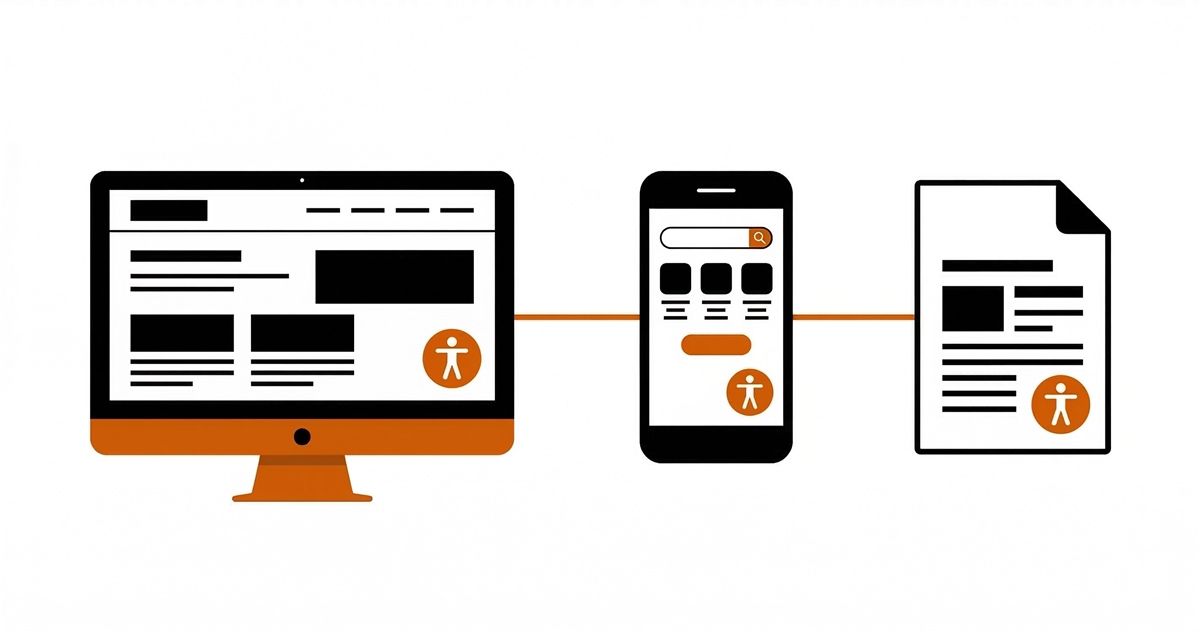
The standard goes beyond web content, however. It also sets requirements for software, mobile applications, and documents. For mobile applications, the standard covers user interface components, non-text content, captions and audio descriptions for video, keyboard and touch accessibility, timing and navigation, and compatibility with assistive technologies including screen readers and switch access devices. For digital documents, it requires proper heading structure, alternative text for images, accessible form fields, reading order, and text contrast ratios that work with low-vision accommodations.
In practical terms, conformance means testing across multiple dimensions. Automated testing tools can identify a portion of WCAG violations, but the most commonly cited estimate from accessibility researchers is that automated tools reliably catch between 30% and 40% of issues. The remainder require manual review: keyboard-only navigation testing, screen reader testing with assistive technology, and user testing with people with disabilities. An organization that relies solely on automated scans to confirm compliance will be carrying significant undiscovered risk going into the 2027 and 2028 deadlines.
The regulations also include a feasibility provision. Where full conformance with the standard is not technically feasible for a specific item, organizations are permitted to offer alternative means of access and must document the reason for non-conformance in their accessibility statement. This is not a broad escape clause. The regulation specifies that feasibility is assessed based on the availability of compliant technology and the financial impact relative to the organization’s capacity. It is not an opt-out for items where conformance would simply be inconvenient or expensive.
Why Starting in 2026 Makes Practical Sense
The December 2027 deadline for federal public sector organizations and the December 2028 deadline for private businesses may feel distant from a March 2026 vantage point. They are not, for reasons that anyone who has managed a web accessibility project at scale will recognize immediately.
First, the assessment phase takes longer than organizations expect. A comprehensive accessibility audit of a government agency website or a major bank’s digital properties is not a two-week exercise. It involves cataloguing every publicly accessible page and application, testing against each applicable criterion, documenting findings in a format that supports remediation prioritization, and producing the gap analysis that the procurement requirement already demands for any new digital purchases. For organizations with complex web estates built over many years on heterogeneous technology stacks, a thorough audit is a multi-month engagement.
Second, the training requirement has a December 2027 deadline regardless of organization size for most federally regulated entities. The training must cover all employees involved in developing, maintaining, or procuring digital technologies. Identifying who those employees are, selecting or building a curriculum that meets the standard’s requirements, scheduling and delivering it, and retaining the records is an organizational project that cannot be compressed into a few weeks before the deadline.
Third, remediation work for web content takes time that is difficult to compress because it competes with other development priorities. An organization that completes its accessibility audit in mid-2027 and discovers 200 web pages with significant conformance gaps will face a remediation backlog it cannot clear before the December 2027 deadline. The organizations that will meet their deadlines cleanly are those that complete their assessments by mid-2026, build remediation into their 2026-2027 development cycles, and enter 2027 addressing residual issues rather than beginning the process.
Finally, the procurement requirement that takes effect in December 2028 means that any new digital product or service your organization is planning to procure in 2027 or 2028 needs to include accessibility assessment in its vendor selection process. That changes how you write RFPs, how you evaluate proposals, and how you structure contracts. Building that procurement language now, before the deadline, means it is embedded in your processes rather than being retrofitted in a rush.
How iWEBAPP Supports Federally Regulated Organizations in Ottawa and Across Canada
iWEBAPP builds websites, web applications, and digital content for federal public sector clients, Crown corporations, non-profit organizations, and private businesses across Canada. Our Ottawa location gives us direct familiarity with the federal government’s digital environment, the standards that apply to it, and the procurement processes through which accessibility requirements are now being written into contracts.
For organizations beginning their Accessible Canada Act digital accessibility preparation, we offer accessibility audits that assess web pages and web applications against the CAN/ASC-EN 301 549 standard and produce the gap analysis documentation that the procurement requirement will eventually formalize. For organizations that have completed an audit and are facing remediation, we build and rebuild the specific components that are generating conformance failures, whether that is a navigation structure that does not support keyboard traversal, a form that is not properly labelled for screen reader use, a colour scheme that fails contrast requirements, or a PDF library that needs to be rebuilt with proper heading and reading order structure.
For new builds, every website we deliver is built to meet the WCAG 2.1 Level AA standard from the ground up. This means that organizations working with iWEBAPP on a new digital property will receive a conformance assessment as part of the project delivery, giving them the documentation the procurement regulations require. It also means the site they launch in 2026 or 2027 will not require immediate remediation to meet the deadlines.
We work with organizations in Ottawa and across Canada. For federal public sector clients and federally regulated private businesses beginning to map their accessibility obligations, the conversation starts with a clear assessment of your current digital properties against the standard. Contact iWEBAPP in Ottawa at +1 613-879-5266, in Toronto at +1 905-872-5266, or at [email protected] to schedule a no-obligation consultation.

Frequently Asked Questions
We would love the opportunity to work with you, but we understand that you may have some additional questions. This quick Q&A covers a lot of the basics. If you have any additional questions, don’t hesitate to reach out.
Lorem ipsum dolor sit amet, consectetur adipiscing elit. Ut elit tellus, luctus nec ullamcorper mattis, pulvinar dapibus leo.
What is the Accessible Canada Act and when did it come into force?
The Accessible Canada Act received Royal Assent on June 21, 2019, and came into force on July 11, 2019. Its goal is to achieve a barrier-free Canada by January 1, 2040. The Act applies to the federal public sector and to federally regulated private-sector organizations in areas including banking, telecommunications, and transportation. It does not apply to provincially regulated businesses.
What are the digital accessibility compliance deadlines under the Accessible Canada Act?
Federal public sector organizations must have new and updated public-facing web pages conforming to CAN/ASC-EN 301 549 by December 5, 2027, and must publish accessibility statements and complete staff training by the same date. Large federally regulated private businesses (500+ employees) and medium-sized ones (100–499 employees) face the equivalent web page requirement by December 5, 2028. Mobile application and digital document requirements, along with procurement assessments, also apply from December 5, 2028 for federal public sector and large private businesses.
What is CAN/ASC-EN 301 549 and how does it relate to WCAG?
CAN/ASC-EN 301 549:2024 is Canada’s national ICT accessibility standard, adopted from the European standard EN 301 549 v.3.2.1. For web content, it incorporates WCAG 2.1 Level A and Level AA requirements. It extends beyond web content to cover mobile applications, software, and digital documents. It is the technical standard that federally regulated organizations must now use to assess and demonstrate their digital accessibility compliance.
Does the Accessible Canada Act apply to my organization if I am based in Ontario?
It depends on how your organization is regulated, not where it is based. If your organization is a federal government department, agency, Crown corporation, or a private business in a federally regulated sector such as banking, telecommunications, or interprovincial transportation, the Accessible Canada Act applies regardless of your Ontario address. If your organization is provincially incorporated and regulated, AODA applies and the Accessible Canada Act does not. Many organizations in Ottawa have both federal clients and provincial regulatory obligations. If you are uncertain, the federal government’s guidance on ACA scope provides a sector-by-sector reference.
My organization already complies with AODA. Does that satisfy the Accessible Canada Act digital requirements?
Partial overlap exists but the two laws are distinct. Both AODA and the Accessible Canada Act require WCAG 2.1 Level AA conformance for web content, so organizations that have already achieved AODA compliance for their websites have completed the web content portion of the Accessible Canada Act’s web requirement for that content. However, the ACA’s Phase 1 Regulations also require training programs, procurement assessments, accessibility statements, and for large organizations, mobile application and document conformance requirements that have no direct equivalent in AODA. An organization that has met AODA should treat that as a foundation, not a completion.
What are the penalties for non-compliance with the Accessible Canada Act digital requirements?
Administrative monetary penalties under the Accessible Canada Act range from $250 to $75,000 depending on the severity and classification of the violation. Non-conformance with the ICT Standard for web pages, mobile applications, and digital documents is classified as a ‘minor’ violation in the current penalty framework. The Act’s intent is to promote compliance rather than to punish, but the penalties are real and increase in severity for repeat violations or where organizations have not demonstrated good-faith efforts toward compliance.
Transportation companies and telecom carriers — are they exempt from the digital requirements?
Transportation Service Providers and Broadcasting and Telecommunications Organizations are not subject to the Phase 1 Regulations’ requirements for public and consumer-facing digital technologies. Their digital accessibility obligations are governed separately by the Canadian Transportation Agency and the Canadian Radio-television and Telecommunications Commission respectively, which have their own accessibility frameworks. These organizations are still subject to the Accessible Canada Act’s planning and reporting requirements and to those Phase 1 requirements that specifically apply to their employee-facing digital content.
What does a digital accessibility audit involve?
A digital accessibility audit tests your web pages, web applications, mobile applications, and digital documents against the applicable criteria of CAN/ASC-EN 301 549. The process combines automated testing tools, which identify a portion of technical violations, with manual review of keyboard navigation, screen reader compatibility, focus management, form accessibility, and other criteria that automated tools cannot evaluate reliably. The output is a gap analysis document that identifies specific failures, their severity, their location in the content, and recommended remediation steps. This documentation is the input to your remediation plan and, once compliance is achieved, forms part of the evidence supporting your accessibility statement.
How long does it take to bring a website into conformance with CAN/ASC-EN 301 549?
Timeline depends on the complexity of the digital property, the volume of content, and the severity of the current accessibility gaps. A relatively simple website with consistent templating can typically be assessed and remediated within eight to sixteen weeks. A large organizational website with hundreds of pages, multiple content types, legacy document libraries, and third-party integrations is a more substantial project. Organizations with dedicated development capacity can address accessibility work in parallel with other projects. Those that rely on an external agency will need to sequence the work appropriately. Starting in 2026 gives most organizations adequate time to complete assessment, remediation, and validation before the 2027 and 2028 deadlines.
How does iWEBAPP approach accessibility compliance for federal clients?
iWEBAPP builds all new websites to meet WCAG 2.1 Level AA from the ground up, which satisfies the web content requirement of CAN/ASC-EN 301 549. For existing sites requiring remediation, we begin with a documented audit that identifies conformance gaps against the standard, prioritize findings by impact and remediation complexity, and build or rebuild the specific components that are generating failures. We provide the conformance assessment documentation that the procurement requirement will eventually formalize. For Ottawa-based federal public sector clients and federally regulated private businesses, we understand the procurement context in which this work takes place and structure our engagement accordingly.
The Compliance Window Is Shorter Than It Looks
The December 2027 and December 2028 deadlines under the Accessible Canada Act are specific, enforceable, and applying to a wide range of organizations that have not historically operated under detailed digital accessibility requirements. The standard they must conform to is the most comprehensive and internationally recognized ICT accessibility standard in use today. The scope of work, from web audits to mobile application assessments to document libraries to procurement frameworks to staff training programs, is larger than it appears from the deadline dates alone.
The organizations that will meet these deadlines without a crisis are those that begin assessment work in 2026, build remediation into their regular development cycles, incorporate accessibility training into their teams’ professional development programs this year, and update their procurement language before they next issue an RFP for digital services. This is not an unreasonable amount of work. But it requires starting now rather than in Q4 2027.
iWEBAPP works with federal public sector clients, Crown corporations, non-profit organizations, and federally regulated private businesses in Ottawa, Toronto, and across Canada. If your organization needs an accessibility audit, a remediation plan, or a new digital property built to meet the standard from day one, the right time to have that conversation is now. Reach us in Ottawa at +1 613-879-5266, in Toronto at +1 905-872-5266, or at [email protected]. The preparation work is the hardest part. We can help with it.


