

Most businesses do not need a mobile app first in 2026. For many Canadian businesses, especially service providers, consultancies, local businesses, and B2B companies, a stronger website, a purpose-built web application, or a Progressive Web App can deliver more value with less cost and less maintenance.
A dedicated mobile app usually makes sense when your business depends on repeat usage, account-based workflows, push notifications, offline access, or a product experience people use frequently. That direction aligns with the latest TechBehemoths market survey, which found that many companies still prefer web-first strategies and that mobile apps are not a universal priority. 
If you are trying to decide where to invest next, the wrong question is not “Should we build an app because everyone is mobile?” The better question is “What digital product best supports our customer behaviour, business model, and growth goals?”
At iWEBAPP, this is the decision we would want a client to make carefully, not emotionally. The answer depends on what your users actually need to do, how often they need to do it, and whether the app experience creates measurable business value that a website cannot match.
For many businesses, investing first in custom website development is the more practical move before committing to a native app.
The 2026 reality: mobile apps are strategic, not automatic
A useful reason to revisit this topic now is that the market has matured. The latest TechBehemoths survey, updated March 27, 2026, collected responses from 2,361 companies across 93 countries. iWEBAPP Agency Inc. is included in the partner companies listed in that article. The biggest takeaway is simple: mobile apps are no longer viewed as a default requirement for every business. Many companies either keep a web-only strategy or are still evaluating whether an app is even necessary. 
That matters because many businesses still start this conversation from the wrong assumption. They see customers using phones all day and jump straight to “we need an app.” But mobile usage does not automatically mean your business needs a native app. It may simply mean your website, booking flow, customer portal, checkout, or internal workflow needs to work better on mobile.
The same survey found that 57.6% of companies see mobile apps as low priority in 2026, 45.1% plan to maintain a web-only strategy, and 54% are still evaluating whether an app fits their business. It also found that one of the most common reasons companies choose not to build an app is that a website is already sufficient.

When a website is enough
For many businesses, a high-performing website is still the best first investment.
That is especially true if your main goals are being found on Google, generating leads, educating prospects, ranking locally, accepting inquiries, booking consultations, or selling a small to medium catalogue online. A strong website is searchable, easier to maintain, lower friction for first-time visitors, and can often deliver a faster return than building and marketing an app.
For most Canadian businesses, a web-first approach is still highly practical because broadband access is now widespread across the country, with Statistics Canada reporting that 96.4% of households had access to high-speed Internet in 2024.
A website is usually enough when:
- You are a local service business and most conversions happen through calls, forms, quote requests, or bookings.
- You are a B2B company where buyers research first and contact later.
- You do not need users to log in frequently.
- Your business does not depend on push notifications.
- Your offering changes often and you want fast updates without app-store approval cycles.
- You want to invest in SEO, paid ads, landing pages, or conversion improvements before adding product complexity.
Best fit for service businesses and lead generation
When SEO and conversion matter more than app installs
This matters for many Canadian businesses. If you are a clinic, contractor, consultant, agency, law office, manufacturer, training provider, or small retailer, the fastest path to growth is often a better website, not a bigger tech stack.
When a web application makes more sense than a mobile app
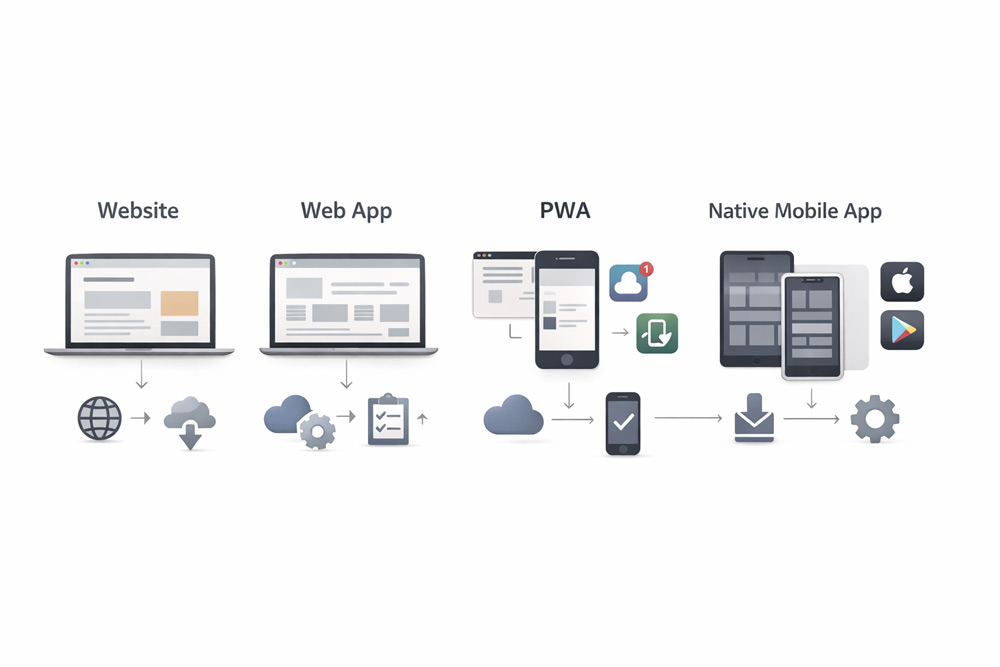
A web application is not just a brochure site. It is a browser-based tool or platform that helps users complete real tasks. That might include quoting systems, dashboards, account portals, booking engines, membership areas, internal business tools, reporting interfaces, learning platforms, or custom workflows.
A web app is often the better choice when you need serious functionality but do not need people to install anything.
A lot of businesses get better value from web applications development because it supports custom workflows without forcing users to install anything.
Common business use cases for web apps
Examples include:
- customer portals
- staff dashboards
- B2B ordering systems
- inventory and operations tools
- membership systems
- e-learning portals
- custom calculators and quoting systems
- appointment and
- workflow platforms
Why browser-based tools often win first
A web app keeps access friction low because users just open a browser. It also reduces duplication because one codebase can support desktop and mobile access more easily than separate native apps.
For many businesses, this is the real middle ground. It gives you product functionality without the cost, maintenance burden, and acquisition challenge of a native app.
Where Progressive Web Apps fit
Progressive Web Apps, or PWAs, sit between websites and native apps. They run in the browser but can provide app-like features such as home-screen installation, improved mobile UX, and in some cases offline behaviour or push notifications.
TechBehemoths specifically notes that some companies are considering replacing an app with a PWA, and its conclusion explicitly says that for some businesses, well-optimised websites and PWAs may deliver greater value than full mobile apps. 
What a PWA can do well
- you want an app-like mobile experience without full native development
- you need faster rollout and easier updates
- you want one product path across devices
- your users may not want to install an app from an app store
- you want a lower-cost first phase before deciding on native mobile
Where PWAs still have limitations
PWAs are not perfect for every use case, but they are often overlooked by businesses that jump too quickly from “website” to “native app.”
When a native mobile app is the right choice
A dedicated mobile app becomes more compelling when the product experience is tightly tied to the phone itself or when repeated engagement is central to the business model.
The TechBehemoths survey points toward industries where apps make more sense, including e-commerce, fintech, marketplaces, on-demand services, and SaaS platforms with frequent interaction. It also found that customer acquisition, revenue growth, and brand visibility are among the top reasons companies invest in mobile apps. 
Business models that benefit most from native apps
A native app is more likely to be worth it when your business needs:
- frequent repeat engagement
- saved user accounts and personalised experiences
- push notifications
- location-aware experiences
- camera or device-native features
- offline usage
- high-performance interactions
- loyalty, retention, and daily or weekly usage patterns
Features that justify native development
Examples include:
- delivery or on-demand services
- booking platforms with repeat customers
- subscription products
- member communities
- marketplaces
- field-service tools
- sales apps for distributed teams
- health or wellness tracking tools
- e-commerce brands with strong retention programs
If users only need your business occasionally, a native app may create more friction than value. If users need you often, a well-built app can become a genuine business asset.
Cost, ROI, and business risk
One reason businesses hesitate is simple: mobile apps are harder to justify if the expected return is unclear. TechBehemoths found that over 55% of companies estimate mobile app budgets below $25,000, while 42.9% have no clear ROI expectations. Low user adoption and high development cost were also among the top reported challenges. 
That should make business owners more disciplined, not more afraid.
The real cost is not just development
The real risk is not just development cost. It is building the wrong product. A weak app usually fails because the business skipped the strategy questions.
Questions to answer before building an app
- Will people use this often enough?
- Does it solve a recurring problem?
- Can we market the app effectively after launch?
- Does it remove friction or add friction?
- Can we maintain it properly over time?
- What job does it do better than our website?
If those answers are weak, you may be better served by improving your web experience first.
What technologies are businesses leaning toward?
If a business does decide to build for mobile, cross-platform approaches continue to be attractive. TechBehemoths found that React Native was the most preferred technology among respondents with a stated preference, and Flutter was also a leading choice. The same survey found that many businesses prefer to build in-house, which suggests companies are prioritising control, speed, and flexibility. 
That does not mean every project should start with React Native or Flutter. It means businesses are looking for practical delivery models, not hype. The best stack still depends on the product requirements, integrations, budget, timeline, device features, and long-term maintenance plan.
A practical decision framework for Canadian businesses
If you are deciding what to build next, use this filter.
Choose a website first if
Your main priorities are visibility, trust, lead generation, and converting traffic into inquiries or bookings.
Choose a web app if
Your business needs custom functionality, dashboards, portals, workflows, or account-based tools, but does not need app-store distribution.
Choose a PWA if
You want an app-like mobile experience with less complexity and lower launch friction.
Choose a native mobile app if
Repeat engagement, retention, push notifications, offline access, or device-specific capabilities are central to the product.
For many Canadian small and mid-sized businesses, the smartest sequence is:
1. Fix and strengthen the website.
2. Add web-based product functionality where needed.
3. Consider a PWA if mobile experience becomes central.
4. Build a native app only when the business case is clear.
That path is usually more efficient, more measurable, and less risky.
What this means for iWEBAPP clients
This is exactly why a web-first strategy often makes sense for iWEBAPP clients.
For businesses evaluating growth in larger competitive markets, our work as a Toronto website design company often starts with a web-first strategy before expanding into app development.
A practical rollout path
Many businesses need better conversion paths, stronger local SEO, cleaner UX, faster mobile performance, smarter forms, better analytics, and custom workflow tools before they need a native app. In those cases, the right move is not to overbuild. It is to build the right thing in the right order.
When to move from web-first to app-first
That might mean:
- a high-converting service website
- a custom WordPress build
- a Shopify or WooCommerce store
- a lead-gen microsite
- a booking or membership system
- a custom portal or dashboard
- an AI-assisted workflow or automation layer
- a PWA roadmap for a later phase
A native app can still be the right answer. It just should be earned by the strategy, not assumed at the start.
At iWEBAPP, we usually help clients decide whether they need a better website, a custom web app, a PWA, or a native app, based on actual business use.
Final answer: does your business need a mobile app in 2026?
Maybe, but probably not first.
If your business depends on repeat use, customer retention, notifications, account-based workflows, or product interactions that people use regularly, a mobile app may be a smart investment.
If your business mainly needs to be found, trusted, contacted, booked, or purchased from, a better website, web app, or PWA is often the stronger move.
The real win is not launching an app. The real win is choosing the digital product that fits your users, supports your revenue model, and gives your business the best chance to grow without unnecessary complexity.
If you want a practical review of your options, contact iWEBAPP and we can help map the right digital product path for your business.
As always, the best business content should follow Google’s helpful content guidance by being useful, specific, and written for real decision-making, not hype.
Why this topic matters in 2026
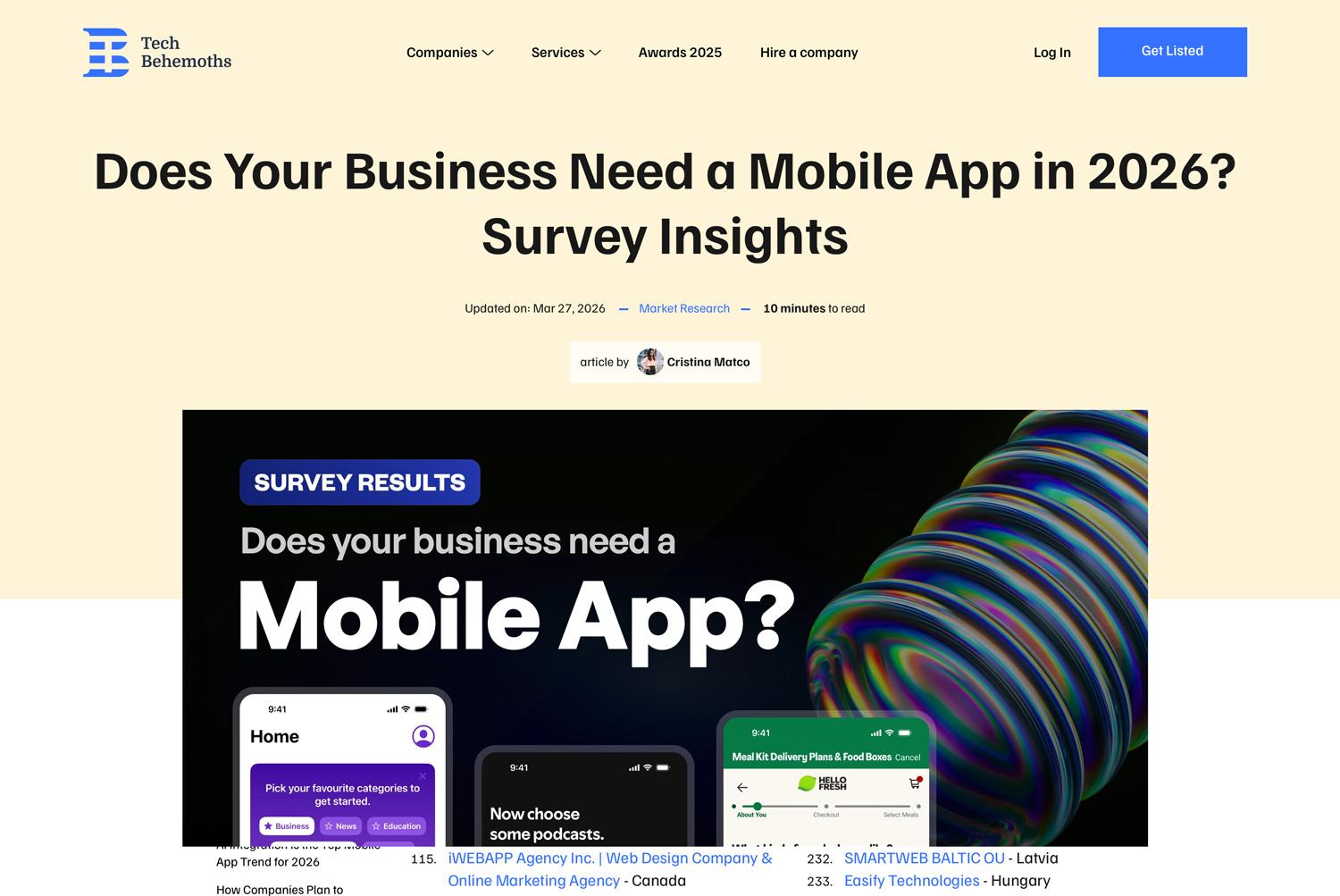
TechBehemoths updated its “Does Your Business Need a Mobile App in 2026?” survey article on March 27, 2026. The article reports input from 2,361 companies across 93 countries, and iWEBAPP Agency Inc. is listed in the partner companies section. We are using that survey as a market reference point, then adding our own practical guidance on when a website, web app, PWA, or mobile app is actually the right business decision.
Turn your website into a search-driven growth engine
Need help deciding between a website, web app, PWA, or native app?
Frequently Asked Questions
We would love the opportunity to work with you, but we understand that you may have some additional questions. This quick Q&A covers a lot of the basics. If you have any additional questions, don’t hesitate to reach out.
Do most businesses need a mobile app in 2026?
What kinds of businesses benefit most from a mobile app?
What is the difference between a website and a web app?
What is a Progressive Web App?
When should a business choose a native app over a PWA?
Are mobile apps expensive to build and maintain?
Should a small business build an app before improving its website?
What technologies are popular for mobile app development in 2026?
How do Canadian consumer preferences affect the choice between web applications and mobile apps?
Canadian consumers increasingly expect mobile-optimized experiences, with over 85% using smartphones for business interactions. Consumer-facing businesses typically see better engagement rates with mobile apps, while B2B companies often find web applications meet professional user preferences. Canadian consumers particularly value convenience and security, making either approach viable when properly implemented.